This Thursday, at Behind This Wall, I will be doing something that I’m still trying to understand while I build it.
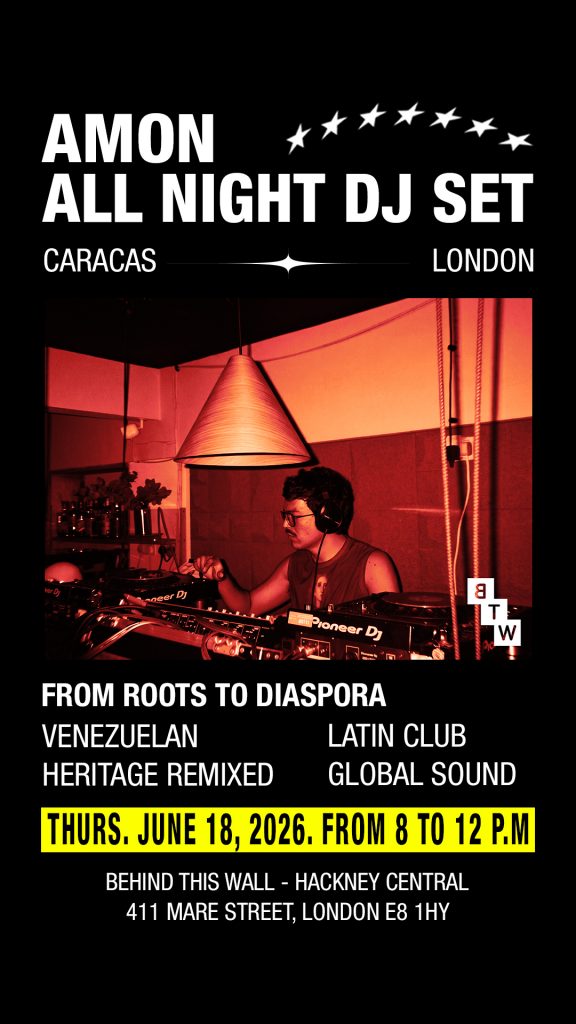
For four hours, I will curate and play Venezuelan music. Not in a linear way. Not as a historical timeline. Not as a “best of Venezuela” playlist. More as an experiment to see what happens when different sounds, moments, voices, and memories from Venezuela are placed next to each other in the same room.
The idea is to show diversity.
Venezuelan music is not one thing. It can be folkloric, electronic, romantic, political, nostalgic, popular, experimental, funny, painful, soft, loud, local, global. It can come from inside Venezuela or from outside. It can be made by people who are deeply connected to tradition, or by people who are simply carrying fragments of that identity somewhere else.
I’m interested in that complexity.
During the set, I will also play small audio fragments between some songs. These will come from interviews, references, or mentions of Venezuelan culture and identity. Some will be in Spanish, others in English. Some might speak from a more “pure” idea of what being Venezuelan means. Others might come from the outside, from a foreign or tourist perspective.
I want to use these fragments almost like samples. Not to explain everything, but to guide the listening a little bit. To make the audience aware that the next song is not just a song, but part of a wider conversation about identity, memory, and culture.
There will also be printed cards placed on the tables of the bar.
On one side, each card will have a lyrical extract from a Venezuelan song. I’m interested in lyrics because they can work almost like small photographs of a culture. A line from a song can reveal a way of speaking, a way of loving, a way of missing home, a political feeling, a landscape, a joke, a sadness, or a shared memory.
These lyrics will come from different times and different kinds of Venezuelan music. Each one will be referenced, so people can know where it comes from.
On the other side of the card, there will be a short text explaining why I’m doing this, who I’m doing it for, and what kind of listening I’m inviting people into.
I will also support the night with projected visuals. I don’t want the visuals to explain Venezuela literally. I want them to help create an atmosphere, and to make the room feel more connected to the music.
Another interesting part of this experiment is the bar itself.
Behind This Wall does not have a traditional cocktail menu. People order based on what they feel, what they want, or what they are craving. The bartender then interprets that and makes something for them.
I want to observe that too.
How do people order drinks in a room filled with Venezuelan music? Does the sound affect what they ask for? Does the atmosphere change the way people describe what they want? This becomes another form of data for me.
Photography and video will also be part of the documentation. I want to capture the night not only as an event, but as a research process. I want to see who dances, who listens, who reads the cards, who recognises a song, who asks questions, and who experiences the music for the first time.
Leave a Reply